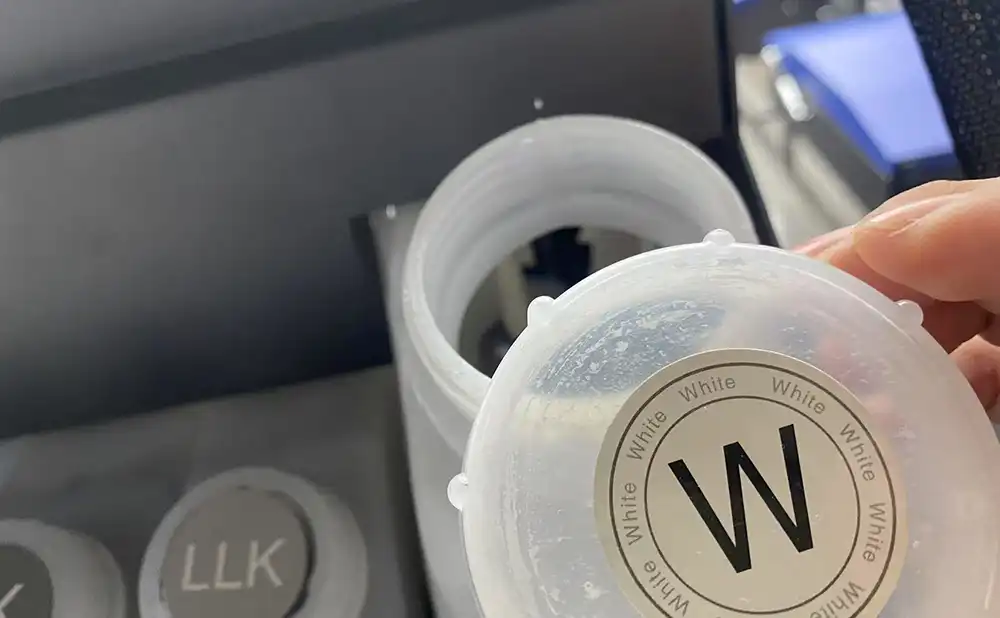
White ink is the backbone of DTF (Direct to Film) printing, serving as the foundational layer that enables vibrant colors on dark fabrics. However, its unique composition—heavy pigments like titanium dioxide suspended in a water-based solvent—makes it notoriously prone to sedimentation and nozzle clogging. Proper management of white ink is essential for maintaining print consistency, reducing downtime, and extending equipment life. This comprehensive guide covers everything from the science behind white ink to practical handling techniques and advanced equipment solutions.
1. Understanding White Ink Composition
White ink differs fundamentally from color inks due to its high concentration of opaque pigments. The primary component is titanium dioxide (TiO₂) , chosen for its exceptional whiteness, covering power, and chemical stability. To keep these heavy particles evenly dispersed, manufacturers add polymer dispersants—molecules that attach to pigment surfaces and suspend them in the liquid. The solvent system is predominantly water, supplemented with alcohols and ethers to control evaporation rate and viscosity, ensuring smooth jetting and proper drying on film.
Because titanium dioxide particles are denser than the solvent, they naturally settle over time. This sedimentation is the root cause of most white ink problems, including color inconsistency and clogged nozzles. Understanding this characteristic is the first step toward effective management.
2. Best Practices for Using White Ink
A. Pre-Printing Preparation
- Thorough Agitation: Before loading white ink into your printer, always shake the container vigorously. Pigment settling occurs even overnight. Use a mechanical shaker for 5–10 minutes if available, or manually invert the bottle repeatedly until the ink appears uniformly opaque. Skipping this step guarantees poor coverage and unreliable prints.
- Filtration: To remove any agglomerates or contaminants, pass the ink through a mesh filter. A 100–200 mesh filter is ideal—fine enough to catch particles yet porous enough to allow fluid flow. This simple step protects your printhead from debris that could block nozzles.
B. Environmental Control
White ink is sensitive to temperature and humidity. The ideal operating environment is:
- Temperature: 20°C – 25°C (68°F – 77°F)
- Humidity: 40% – 60%
Deviations can alter ink viscosity, leading to poor jetting, excessive drying, or bleeding. Use air conditioning and humidifiers/dehumidifiers to maintain stable conditions in your print room.
C. Printing Parameter Optimization
- Nozzle Height: Maintain a gap of 1.5 mm – 3 mm between the printhead and the film. Too high, and ink drops will be displaced by air currents; too low, and you risk scratching the printhead.
- Print Speed: Because white ink is thicker, reducing speed improves transfer accuracy. Set your printer to 30% – 60% of maximum speed and run test prints to find the sweet spot for your specific ink and film combination.
3. Proper Storage of White Ink
Long-term storage can degrade white ink if conditions are not controlled.
- Temperature and Light: Store ink in a cool, dark place between 5°C and 25°C (41°F – 77°F) . Avoid direct sunlight and heat sources, which can cause chemical breakdown and evaporation. A dedicated cabinet with UV protection is recommended.
- Sealing: Oxygen and moisture are enemies. Always tighten caps immediately after use. For extended storage, consider flushing the container with an inert gas like nitrogen to prevent oxidation. Never return unused ink to the original bottle—this introduces contaminants.
4. Dealing with Nozzle Clogging
Even with careful handling, clogs happen. Here’s a tiered approach to clearing them.
A. Routine Maintenance
- Run the printer’s built-in cleaning cycle every 2–3 days, even if you aren’t printing daily. This flushes fresh ink through the nozzles and prevents dried ink buildup.
B. Soaking
For moderate clogs, remove the printhead (following manufacturer instructions) and soak it in a specialized cleaning solution for 1–2 hours. Rinse with distilled water before reinstalling. Never use tap water, as minerals can cause further blockages.
C. Ultrasonic Cleaning
Stubborn clogs may require an ultrasonic cleaner.
- Place the printhead in the cleaner with enough cleaning solution to submerge the nozzles.
- Use 300W – 500W power for 5–10 minutes. Exceeding these limits can damage the delicate piezoelectric elements. After cleaning, rinse and test.
5. Advanced Equipment Features: How Modern Printers Help
Many contemporary DTF printers incorporate technologies that actively combat white ink sedimentation. For example, KEDITEC’s DTF printers feature an innovative white ink circulation and agitation system. This two-level system includes:
- Primary stirring: Gently mixes ink continuously to prevent settling.
- Secondary tumbling: Provides more vigorous agitation to homogenize the ink fully.
Combined with an automatic humidification system, these features maintain optimal ink viscosity and fluidity throughout long print runs, dramatically reducing clogs and extending ink life. When choosing a printer, look for such integrated ink management systems—they save significant time and money over the machine’s lifetime.
Conclusion
Mastering white ink handling is essential for any DTF printing operation. From understanding its chemical nature to adopting rigorous preparation, storage, and maintenance routines, every step contributes to reliable output and lower costs. By combining good practices with advanced printer features like those found in KEDITEC models, you can minimize downtime and achieve consistently high-quality prints.