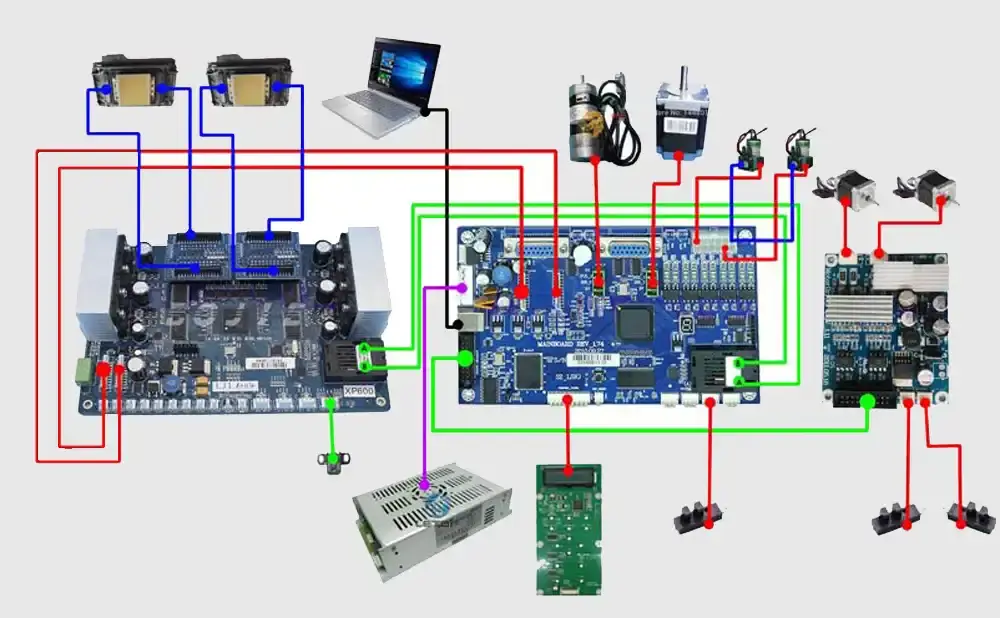
Among the many core components of Direct-to-Film (DTF) printers, industrial control boards serve as both the “brain” and the “neural network.” They coordinate critical functions including print head movement, ink ejection, data transmission, and drive control—directly impacting print precision, equipment stability, and production efficiency.
This article provides a systematic overview of the four main functional modules of DTF printer control boards, common failure types, daily maintenance practices, and selection recommendations.
1. Four Functional Modules of DTF Printer Control Boards
Based on their functions, DTF printer control boards can be divided into four main modules. As technology advances, some modules may become further integrated in the future.
1.1 Main Control Board
The main control board is the core control component of the printer, comparable to a computer’s motherboard. It coordinates the operation of various printer components, including print head movement, ink ejection, transmission system operation, and communication with computers or external devices.
Different DTF printer models feature main control boards with varying performance levels. High-end models typically have stronger processing capabilities and more stable performance, supporting higher print resolution, faster printing speeds, and more complex print jobs.
1.2 Print Head Driver Board
The print head driver board is primarily responsible for driving the print head, precisely controlling the ink ejection volume and timing of each nozzle within the print head. The performance of this board directly affects print quality—specifically whether precise droplet control can be achieved to ensure image detail and color accuracy.
Some high-quality print head driver boards also feature print head fault detection and automatic compensation. When a nozzle fails, the system automatically adjusts ink droplet distribution to minimize impact on print results.
1.3 Drive Control Board
The drive control board manages the printer’s transmission system, including motors, belts, gears, and other components, ensuring that the print platform and print head move accurately along preset paths.
The precision of this board is critical for print accuracy—it determines positional accuracy and repeatability of printed patterns, preventing issues such as pattern misalignment or deformation. Advanced drive control boards support multiple movement modes and speed adjustments to accommodate different printing materials and requirements.
1.4 Interface Board
The interface board provides connections between the printer and external devices (such as computers, scanners, and storage devices). Common interface types include USB and Ethernet.
The interface board enables fast data transmission and stable communication, ensuring the printer receives print commands and image data from external devices in a timely manner. Some interface boards also feature data processing and caching functions to optimize transmission and processing efficiency during printing.
2. Brand Recommendations and Selection Guidance
When selecting DTF printer control boards, consider factors such as compatibility, stability, performance, and scalability. High-quality boards improve overall printer performance and reliability, reduce failure probability, and provide support for future equipment upgrades and functional expansion.
The following brands are commonly recognized in the industry:
- Hanson: Hanson boards are frequently used for adapting Epson print heads and have a significant market share in inkjet printers, digital textile printing, and UV printers. Their products offer advantages in signal transmission stability and print head control precision.
- Weiliyin: Offers customized development of full series board products—including main boards, carriage boards, driver boards, button boards, and cover boards—providing tailored solutions for printing equipment manufacturers and printing enterprises.
- Hongmei: Boards offer good compatibility with multiple print head and printer models.
Keditec DTF Printer Configuration: Boards can be ordered according to customer requirements, with Hanson boards used as the default option.
3. Common Failure Types and Identification
Main Control Board Common Failures
- Faulty power chips or capacitors, making the printer difficult to start
- Faulty crystal oscillators, causing instability or frequent crashes after startup
- Faulty interface chips, leading to failed device connections
- Faulty communication chips, resulting in data transmission issues
Print Head Driver Board Common Failures
- Faulty driver chips or power circuits, causing the print head to stop ejecting ink
- Signal line issues, leading to streaks or missing dots in printed patterns
- Control program errors, causing incorrect print colors
Drive Control Board Common Failures
- Faulty motor driver chips, causing print head jams or unstable speeds
- Faulty position sensors, leading to inaccurate print head positioning
- Communication failures with the main control board, causing pattern misalignment or deformation
Interface Board Common Failures
- Dirty or loose interfaces, leading to unstable device connections
- Faulty filter circuits, causing data transmission interference
- Faulty data conversion chips, leading to incorrect reception of print commands
4. Daily Maintenance and Failure Prevention
4.1 Keep Clean
Dust can cause poor heat dissipation or even short circuits. Use compressed air cans or soft brushes to clean areas prone to dust accumulation, such as fans, heat sinks, and interfaces. Avoid placing liquids near the printer; if liquid spills accidentally, power off immediately, absorb the liquid with paper towels, and let it air-dry or use a low-temperature hair dryer.
4.2 Maintain Suitable Environment
The ideal temperature range is 15–30°C, with humidity between 40% and 60%. Use air conditioners or dehumidifiers if necessary. Keep the printer away from large motors, transformers, and other sources of electromagnetic interference. Use shielded data cables and ensure proper grounding.
4.3 Follow Standard Operation Procedures
When powering on, turn on the printer first, then the computer; reverse the order when shutting down. Avoid frequent switching, as it can stress the boards. Never plug or unplug boards or cables while the printer is running. After shutting down, wait for capacitors to discharge before performing any operations.
4.4 Conduct Regular Inspections
Check for loose or oxidized board interfaces and damaged cables, repairing or replacing them promptly. Monitor manufacturer-released driver and firmware updates and install them in a timely manner. Use tools like multimeters to regularly test power circuits and signal lines to identify and resolve potential issues in advance.
Conclusion
The electronic control boards of DTF printers are functionally divided into four modules: main control, print head driver, drive control, and interface. The main control board serves as the core, coordinating all components; the print head driver board controls ink ejection and affects print quality; the drive control board ensures precise movement paths; and the interface board enables data transmission with external devices.
When selecting boards, consider factors such as compatibility and stability. Recommended brands include Hanson, Weiliyin, and Hongmei. Keditec DTF printers use Hanson & Beijing boards by default, with customization options available.
Daily maintenance should focus on cleanliness, environmental control, standard operating procedures, and regular inspections to effectively reduce failure rates and extend equipment service life.
Authoritative References
The following industry resources provide additional technical guidance on printer control systems and equipment maintenance:
Understanding Printer Control Systems – Specialty Graphics Imaging Association
https://www.sgia.org/resources/printer-control-systems
Digital Printing Equipment Maintenance Guide – PRINTING United Alliance
https://printing.org/technical-resources/equipment-maintenance
Industrial Electronics in Printing – SGIA Technical Services
https://www.sgia.org/technical-services/industrial-electronics