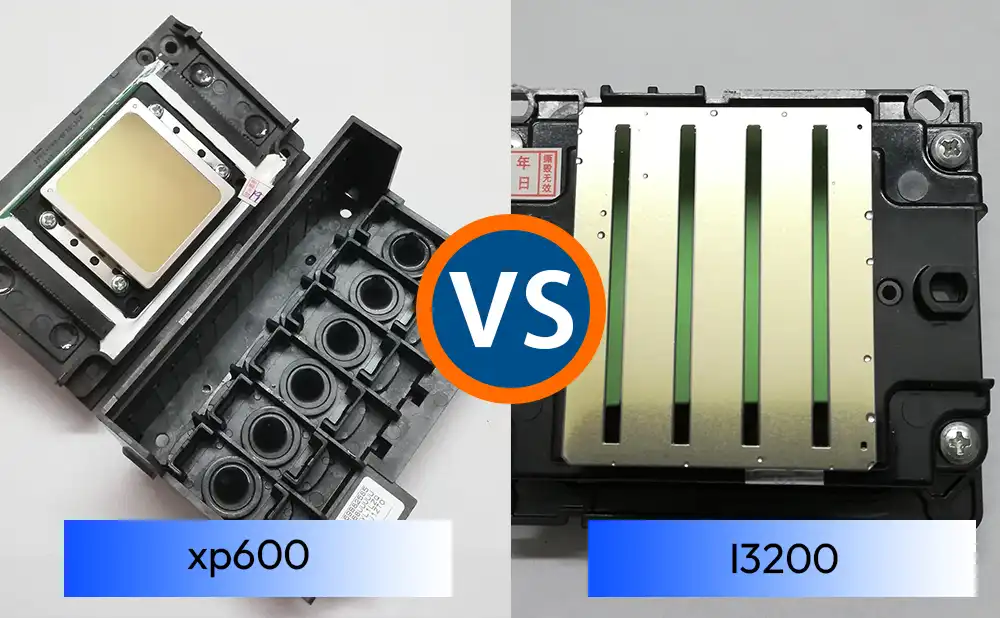
In the digital printing industry, the print head is the core component determining your output quality, production efficiency, and operating costs. For businesses involved in DTF (Direct-to-Film), UV, or eco-solvent printing, the debate often comes down to two popular Epson models: the XP600 and the I3200.
While both are manufactured by Epson, they are designed for entirely different audiences and applications. This guide provides a technical and commercial comparison to help you make the right investment for your business.
1. Core Technical Specifications
Understanding the hardware differences is the first step. The I3200 represents a significant leap in technology over the aging XP600.
- Nozzle Count: The XP600 features 600 nozzles total, while the I3200 boasts 3200 nozzles (600 per channel) . This immediately translates to higher potential speed.
- Resolution: The I3200 utilizes PrecisionCore MEMS technology, capable of true 600dpi native resolution and supports Variable-Sized Droplet Technology (as small as 3-4pl) for smoother gradients .
- Print Speed: For production environments, speed is critical. The XP600 typically prints at 10-12 square meters per hour, whereas the I3200 can reach speeds of 35 square meters per hour or more in standard modes .
- Effective Print Width: The I3200 offers a print width of approximately 33.8mm (1.33 inches) .
2. Application Suitability
Choosing the wrong head for your application can lead to poor efficiency or high maintenance.
The Epson XP600 is considered an entry-level head. It is commonly found in smaller desktop conversion printers. It is suitable for:
- Hobbyists or startups testing the DTF market.
- Low-volume production studios.
- Applications where initial budget is the primary constraint.
However, its shorter lifespan (often 3-6 months in continuous production) makes it costly for high-volume work .
The Epson I3200 (Specifically the I3200-A1) is built for industrial use. It is the standard for high-end DTF and UV printers. It excels in:
- High-volume garment decoration and fulfillment centers.
- Printing on dark garments requiring heavy white ink underbase (better ink flow management).
- Businesses looking for scalability without constantly replacing heads .
The I3200 is also more versatile with ink types, handling UV, eco-solvent, and water-based pigment inks with greater stability .
3. Investment and Cost Analysis (USD)
The price difference is significant, but it must be viewed as an investment rather than a cost.
- Print Head Cost: A genuine Epson XP600 head typically retails in the range of $260 to $290. In contrast, an Epson I3200-A1 head is priced between $830 and $860 .
- Printer Cost: If you are buying a full printer, the price gap is even wider. A printer equipped with dual I3200 heads can be roughly $700 to $1,400 more expensive than an XP600 model due to the associated control boards and components .
4. Longevity and ROI (Return on Investment)
While the I3200 requires a higher upfront payment, it offers better long-term value.
- Lifespan: The XP600 may need replacement every 3-6 months under heavy use. The I3200 is engineered to last 1 to 3 years with proper maintenance .
- Maintenance: Because the I3200 is designed for industrial duty cycles, it suffers from less downtime due to clogging, especially with white ink circulation systems common in DTF .
- Profitability: The I3200 produces more salable square meters per hour. If you have orders to fulfill, the speed of the I3200 allows you to take on more work and meet tight deadlines, directly impacting your bottom line.
Conclusion: How to Choose?
Your choice depends entirely on your business stage and goals.
- Choose the Epson XP600 if: You are a beginner, your budget is extremely tight (under $300 for a head), and you are printing fewer than 10-20 garments per day. It allows you to enter the market, but be prepared for potential replacement costs down the line.
- Choose the Epson I3200 if: You are running a professional print shop, you need to produce high volumes quickly, or you are printing on dark fabrics that require heavy white ink layers. It is the tool for serious commercial printing and offers a better total cost of ownership over 24 months.